
Starting IVF can feel confusing when you do not know what happens at each stage. IVF (in vitro fertilization) is a fertility treatment in which eggs are collected from the ovaries, fertilized with sperm in a laboratory, and the resulting embryo is transferred into the uterus.
The IVF process usually includes fertility testing, treatment planning, ovarian stimulation, monitoring, egg retrieval, fertilization, embryo development, embryo transfer, and a pregnancy test. The exact steps and timing can vary depending on your age, ovarian reserve, fertility diagnosis, previous treatment, and the protocol recommended by your fertility specialist.
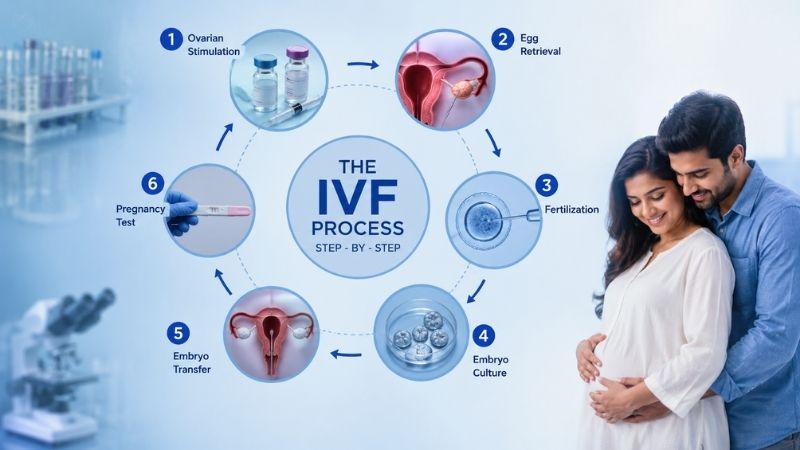
IVF Process Step by Step
The IVF process step by step can be understood as a series of stages. Here is a simple overview:
| IVF Stage | What Happens | General Purpose |
| Fertility consultation | Medical history and fertility tests are reviewed | To plan suitable treatment |
| Ovarian stimulation | Fertility medicines help the ovaries develop multiple follicles | To obtain mature eggs |
| Monitoring | Ultrasound scans and sometimes blood tests are performed | To track follicle growth |
| Ovulation control | Medicines may be used to prevent premature ovulation | To keep the cycle controlled |
| Trigger injection | A final injection helps prepare the eggs for retrieval | To support final egg maturation |
| Egg retrieval | Mature eggs are collected from the ovaries | To obtain eggs for fertilization |
| Fertilization | Eggs and sperm are combined in the laboratory | To create embryos |
| Embryo development | Embryos are monitored for several days | To select an embryo for transfer when appropriate |
| Embryo transfer | An embryo is placed into the uterus | To give implantation a chance |
| Pregnancy testing | A blood test checks for pregnancy | To determine the treatment outcome |
1. Initial Fertility Consultation and Testing
The IVF treatment process usually begins with a consultation. Your fertility specialist may review your medical history, previous fertility treatments, menstrual history, and any known fertility problems.
Tests may include ovarian reserve assessment, ultrasound examination, hormone testing, and semen analysis. Other tests can be recommended depending on the individual situation.
The purpose is not simply to start IVF. It is to understand the factors affecting fertility and decide whether IVF is appropriate and which treatment approach may be suitable.
2. IVF Treatment Planning
After the initial evaluation, the doctor creates an individual treatment plan. This may include decisions about the stimulation protocol, monitoring schedule, fertilization method, embryo culture, and transfer plan.
This is an important part of IVF preparation because every patient does not follow exactly the same protocol.
3. Ovarian Stimulation
One of the main steps of IVF treatment is ovarian stimulation. Fertility medicines are used to encourage the ovaries to develop several follicles rather than relying on the single egg normally released during a natural menstrual cycle.
These medicines are commonly given as IVF injections, but the exact medicines and treatment schedule depend on the patient’s needs.
Patients should use fertility medicines only as prescribed by their fertility specialist. Doses and timing should not be changed without medical advice.
4. Monitoring and Preventing Premature Ovulation
During stimulation, regular monitoring helps the fertility team check follicle growth and ovarian response. Ultrasound scans and, when needed, blood tests can help the doctor decide how the cycle is progressing.
Medicines may also be used to prevent premature ovulation before the eggs are ready for collection. The monitoring schedule can differ between patients.
5. Trigger Injection
When the follicles have developed appropriately, the doctor may prescribe a trigger injection. This helps the eggs complete their final maturation before egg collection.
Timing is important, which is why the fertility team gives specific instructions about when the trigger should be taken and when the egg retrieval will occur.
6. Egg Retrieval in IVF
Egg retrieval in IVF is a procedure used to collect mature eggs from the ovaries. It is generally performed using ultrasound guidance and sedation or anaesthesia, depending on the clinic and patient.
A thin needle is guided through the vaginal wall to reach the follicles and collect the fluid containing the eggs.
After the procedure, some patients may experience mild cramping, pelvic discomfort, bloating, or light spotting. Your fertility team will explain what is normal for your situation and when you should contact them.
7. Sperm Collection and Preparation
Around the time of egg retrieval, a sperm sample is usually collected and prepared in the laboratory.
The laboratory team processes the sample to identify suitable sperm for fertilization. Depending on the fertility diagnosis and treatment plan, the specialist may recommend conventional IVF or a procedure such as ICSI, in which a single sperm is injected directly into an egg.
8. IVF Fertilization Process and Embryo Development
The IVF fertilization process takes place in the embryology laboratory. After fertilization, the resulting embryos are monitored as they develop.
Embryos may be cultured for several days before a transfer is considered. Not every retrieved egg will fertilize, and not every fertilized egg will continue developing into an embryo suitable for transfer.
This is one reason why IVF outcomes can differ from one person to another.
9. Embryo Transfer Process
The embryo transfer process involves placing a selected embryo into the uterus through a thin catheter. The procedure is usually relatively brief and does not require the same type of procedure as egg retrieval.
In some situations, embryos may be frozen and transferred in a later cycle rather than immediately. The decision depends on the treatment plan, embryo development, medical circumstances, and clinic protocol.
10. Progesterone and Luteal Support
After egg retrieval and embryo transfer, the fertility specialist may recommend progesterone or other luteal support.
These medicines are intended to support the uterine lining during the period when implantation may occur. The type, route, and duration of treatment vary, so patients should follow the plan provided by their fertility team.
What Happens After Embryo Transfer?
After embryo transfer, there is a waiting period before pregnancy can be confirmed. You may be asked to continue prescribed medicines during this time.
It is normal to feel anxious during this stage because symptoms alone cannot reliably confirm whether implantation has occurred.
A pregnancy blood test is generally scheduled by the fertility clinic at an appropriate time after transfer. Testing too early can make the result difficult to interpret.
How Long Does the IVF Process Take?
The IVF treatment timeline is not the same for everyone. Some parts of treatment may begin before ovarian stimulation, while others may take place over several weeks or across more than one menstrual cycle.
The overall timeline can depend on the treatment protocol, required tests, ovarian response, embryo development, whether embryos are transferred fresh or frozen, and whether additional procedures are needed.
Therefore, there is no single number of days that applies to every IVF cycle.
What to Expect During IVF Treatment
Knowing what to expect during IVF treatment can make the process feel more manageable. During a cycle, you may have:
- Several clinic appointments
- Ultrasound monitoring
- Blood tests when required
- Fertility medicine injections
- An egg retrieval procedure
- Sperm collection
- Laboratory fertilization and embryo monitoring
- Embryo transfer
- A waiting period before pregnancy testing
Emotional stress can also be part of IVF. Asking your fertility team questions and understanding your treatment schedule can help you feel more prepared.
How to Prepare for an IVF Cycle
Before treatment begins, consider asking your fertility specialist:
- Which IVF protocol is being recommended and why?
- What tests are required before starting?
- How often will monitoring appointments be needed?
- Which medicines will be used during the cycle?
- What should I know about storing and handling medicines?
- What happens if the ovaries respond more or less than expected?
- Will embryo transfer happen in the same cycle or later?
- When should the pregnancy test be performed?
- What symptoms should be reported to the clinic?
You can also keep a written treatment schedule and follow your clinic’s instructions carefully.
FAQs
1. What are the steps of the IVF process?
The main steps include fertility assessment, treatment planning, ovarian stimulation, monitoring, ovulation control, trigger injection, egg retrieval, sperm preparation, fertilization, embryo development, embryo transfer, luteal support, and pregnancy testing.
2. How long does the IVF process take?
The timeline varies between patients. Testing, stimulation, retrieval, embryo development, transfer, and pregnancy testing may occur over several weeks or across different cycles depending on the treatment plan.
3. Is IVF painful?
Some parts of IVF can cause discomfort. Injections may sting, stimulation can cause bloating or pelvic pressure, and egg retrieval may involve temporary discomfort. Clinics use appropriate pain relief or sedation for the retrieval procedure.
4. How many injections are needed during IVF?
There is no fixed number. The number and type of IVF injections depend on the treatment protocol, ovarian response, and medicines prescribed by the fertility specialist.
5. What happens after egg retrieval?
The collected eggs are assessed in the laboratory. Sperm is prepared and fertilization is performed using the method selected for the treatment. Embryos are then monitored as they develop.
6. How long does embryo transfer take?
The actual embryo transfer process is generally brief. The exact duration can vary depending on the clinic and individual circumstances.
7. When can you take a pregnancy test after IVF?
Your fertility clinic will advise when to take the pregnancy test. A blood test is commonly used because it can provide a more reliable assessment than testing too early at home.
8. What happens if IVF does not work?
A failed cycle does not automatically mean that future treatment cannot work. Your fertility specialist may review the cycle, embryo development, ovarian response, and other factors before discussing possible next steps.
9. Can IVF be done in one cycle?
Egg retrieval, fertilization, embryo development, and transfer can occur within one treatment cycle in some cases. However, some patients may need a frozen embryo transfer or additional cycles depending on their circumstances.
10. What should I expect during IVF treatment?
Expect regular appointments, scans, possible blood tests, fertility injections, egg retrieval, laboratory procedures, embryo transfer, and a waiting period before pregnancy testing. The exact experience varies from patient to patient.
Taking the Next Step With Your IVF Plan
Understanding the stages of IVF can make an unfamiliar treatment process easier to follow. IVF involves several carefully timed steps, but your exact plan should always be based on your fertility assessment and specialist’s advice.
If your doctor has prescribed fertility or IVF medicines, use them only according to the prescribed treatment plan. For medicine information and enquiry support, Indian Pharmazee provides speciality medicine services, including IVF medicines, with support for prescription queries and temperature-sensitive products.
Contact us at Indian Pharmazee for medicine-related enquiries and assistance. Always consult your fertility specialist before starting, stopping, or changing any IVF medicine.